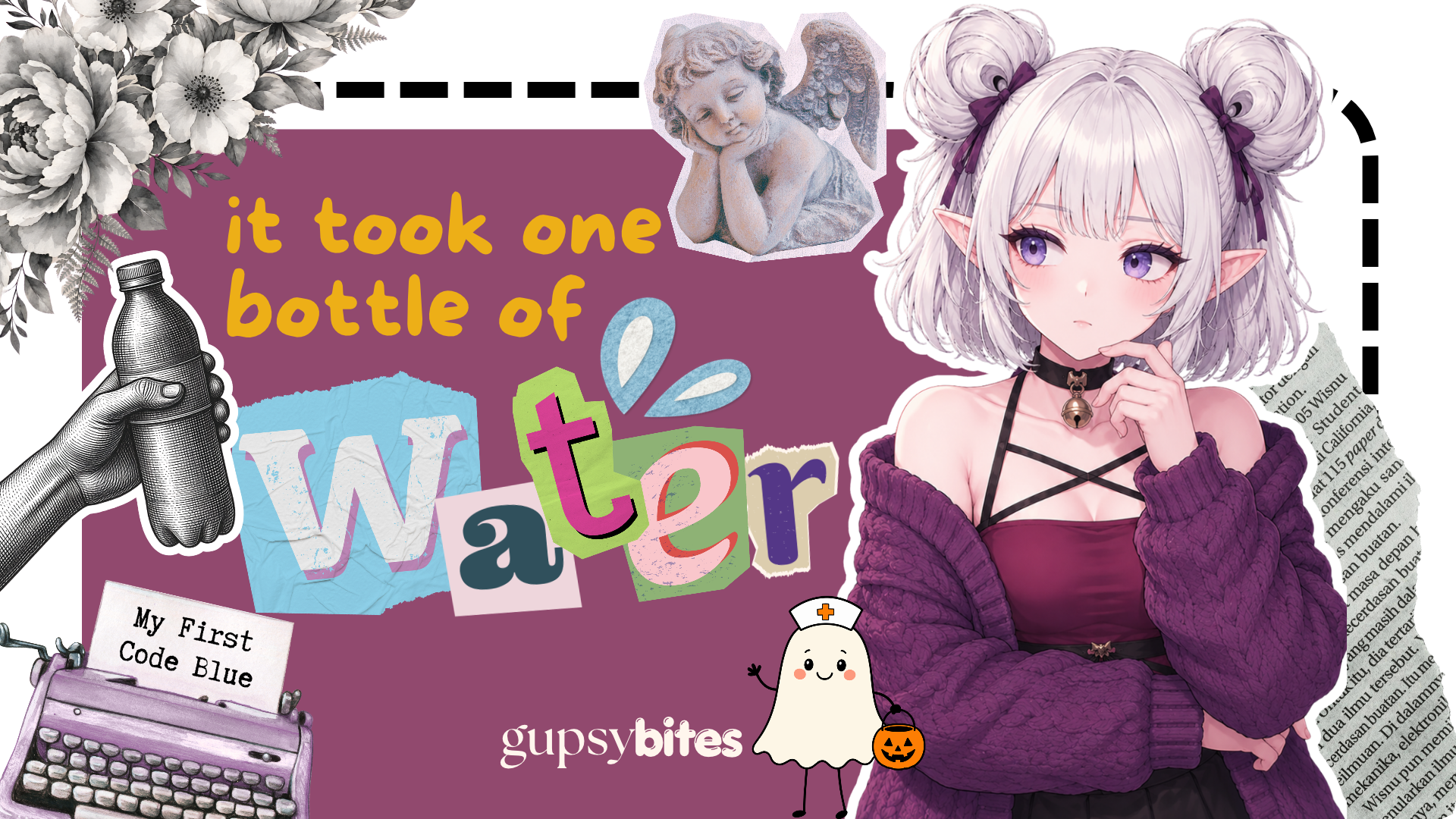
Let me tell you about a hospital encounter that I swear still sends chills down my spine to this day. No, this is not that kind of graveyard shift story. And it has something to do with just sipping a bottle of water.
“Did you know that one wrong gulp can kill you?” I told my friends one night when we were out drinking. I was in my early 20s then, a fresh grad and passer, on my first hospital year as an actual nurse.
I just witnessed something so terrifying the other day but chose to silently gaslight myself into thinking that duh, you work in a hospital, this is reality–people die every day. And so as quickly as my friend turned that conversation into something salacious, I immediately bottled the grief and existential thoughts inside a neatly wrapped box of dirty jokes.
But it was serious. Someone really died. And I think about her every time I drink a glass of water.
A quick note before we dive in. This is a real story, there are real people who died. This was back in 2013 so my recollection is only the significant ones and how I felt about it. It was my first code blue so if I sound like I’m romanticizing it in any way, that’s just the writer me trying to make sense of the trauma. For anonymity’s sake, there will be no mention of the patient’s name nor the hospital I worked for. Let’s just say if you know me, you know. I pray for that woman who passed, and I hope that this re-telling might help someone.
5am at the ob ward
and why we nurses shut up about the ward being chill
It was 5AM on the night shift–the time when nurses are usually gearing towards going home while prepping 6AM meds, completing charts and writing endorsements. We were all in our designated areas in the nurses’ station. And we try as much as possible not to say it.
Today was quiet.
I believe any medical professional who has seen chaos drop in the middle of a peaceful shift know never to utter those words nor acknowledge the silence. I never really challenged the absurdity of this rule but time and again it happened, as if the angel of death was just waiting to hear those magic words before he attacked. And so we’re all hushed up, minding our own business, looking at each other from time to time but seriously keeping our mouth shut.
Just to paint a picture, I was working on a charity ward of 20-40 patients. Usually most of them have just delivered babies or are post-op from any gyn related procedures and only 10% of the time do we get anything that requires extra handling. In the morning it could get a bit chaotic, but graveyard shift could be more capricious. If it’s quiet, it’s quiet. But when it’s not, it haunts you for life.
Someone finally said it. While stretching and yawning, one of the nurses said “Saya naman nitong shift…” (this is a fun shift) implying the lack of toxicity and stress. Me being a dum-dum piled on “yeah sana ganito palagi…” (I hope it’s like this all the time)
It didn’t take long until the mother of the patient from room 309 approached the nurses’ station.
the code
and the little moments that nailed the coffin
The mother casually approached the nurses’ station and asked us to check her daughter who just gave birth that day. She said she seemed to be having difficulty breathing. She said it so casually and non-urgently that we didn’t immediately pick up on how seriously we should have responded to it. The patient delivered a baby via NSD, no complications, no anything and she was set for discharge that day. Her chart was almost done, just waiting for closing. Could be nothing, right?
Upon arriving inside the patient’s room, she was already unconscious and unresponsive even to a sternal rub. O2 Sat showed 81%, she was already cold with no pulse so we immediately starting doing CPR. The senior nurse had to call the resident on deck multiple times and had to yell at the guard to knock at the residents’ office (I’m assuming she was asleep and cannot be reached). If every mistake had a bell, it would have rung twice now.
I guess it was the lack of sleep but the patient’s mother stood there nonchalantly, still trying to process what was happening. The senior nurse pulled her aside and asked what exactly happened.
And this was just a re-telling by the nurse later on. At that time I couldn’t really hear anything because we were in the middle of it. According to the senior nurse, the patient woke up with a dry throat and asked for water. The mother casually handed her a bottle of water, which she drank while lying down. At first, she started coughing hard. Nasamid, in Tagalog. A common practice was when you see someone in this situation, you give them more water to calm down the coughing. So she did, gave her back the bottle of water and told her to drink more. At first, it seemed to work. The coughing died down. Then she started deep breathing (which I assumed was already gasping), but was still able to coherently tell her mother to call the nurses. She was actively drowning at that time.
I want to be very clear about something before you judge the mother. I believe she was just doing what most of us have the instinct to do. Most of us aren’t taught otherwise. Aspiration and asphyxia can be intimidating medical terms and I’m not sure education on these is part of the algorithm that the older population scroll to. I had to remind my mother about this time and again. Sometimes she gulps her coffee mindlessly and starts coughing and before she grabs water to let the coughing “die down”, I tell her to let the body do what it does first before you intervene.
Anyway, back to the scene.
The resident finally arrived. I can’t really clock everything at this point as everything happened so fast. But I specifically remember that she struggled with intubating the patient. Because of the delay, the throat was already a bit swollen and lo and behold, the laryngoscope started flickering.
The battery died while she was trying. If this doesn’t give you goosebumps, I don’t know what will.
We’re at a full force at this time. All the nursing attendants and the nurses available on that ward were taking turns with chest compressions and trying to find a fucking battery replacement. I had to run to different wards just to borrow a battery. And I don’t mean to judge government hospitals, but I’m judging. That was when I found out that each floor had one battery for their laryngoscope and nobody even bothered to help. Every senior nurse I came across was like no we can’t let you borrow our laryngoscope battery. And by the time I reached the 7th floor (and mind you, I ran the stairs) and got the same no, there it was, the third bell rang in my head.
I thought there was no way this patient was going to make it. Thankfully, as I arrived with my lungs out of my throat, the patient was intubated already. One of the nurse attendants was clever enough to take the battery from the clock in the nurses’ station. Should have thought about that before I ran bravely and witnessed the no-fucks-given nature of people. But I couldn’t blame them I guess. It was easy for me to resent them as if they did not want to help, but they’re only looking out for their own ward like what if they get the same emergency and had no battery for a laryngoscope, right?
Despite that, the patient still did not make it. The attending physician arrived straight from the operating room (she was in the middle of a caesarean section when she was notified). The resuscitation efforts had gone past 30 minutes so she called it. The clock lost its battery a few minutes ago but this is the exact moment that time stopped.
The new mother, who delivered a healthy baby boy and was set for discharge that day, was gone.
All because of a wrong sip of water.
the aftermath
what I still carry to this day
It still circles my mind to this very day. I didn’t know that woman personally but a part of me still grieves her every time I drink water. I don’t think I’m the only one holding on to this trauma. I wasn’t even in charge of her, and what was more annoying was that I had to render care to the 15 ish patients that were actually assigned to me that day. I still had to put on a ‘professional’ mask, pretending that it’s business as usual.
And then I saw them. The patient’s husband and maybe her other kid, arriving with balloons and a Red Ribbon cake. All excited and blissfully ignorant of what just happened. We were just finishing the endorsements when we heard it all. It was devastating to say the least.
This wasn’t my first encounter with death though.
I came from Legazpi City and as a kid, I was there when they hauled the bodies in the basketball court for identification after Typhoon Reming. I still remember the smell and the non-stop wailing. I thought I was simply nonchalant about the notion of death. Like an “it is what it is” kind of mindset.
I guess it has something to do with getting older and the fact that as a nurse I’ve somehow developed some sort of empathy for humanity. But just the way she died–that really stuck with me. Yes, people die from typhoons, earthquakes and other natural calamities. People die from getting shot or from debilitating diseases. But not a lot from just drinking water wrong.
I’m not sure how some tenured nurses are able to witness human moments like this without falling apart themselves. Our senior nurse was at the top of her game that day and I really looked up to her the way she handled things professionally. She was able to assist the patient’s relatives with kindness and empathy, and with full composure. I had to hide in the toilet just to cry. I did see the attending physician and senior nurse cry as soon as the patient was wheeled out to the morgue, which was humanizing for a new nurse like me. There were times when I assumed that healthcare workers just get used to people dying all the time that it stops being something to grieve about.
But yeah. I guess the takeaway from this is that “When it’s your time, it’s your time.” There’s no perfect time or place for it, and no matter how healthcare workers try, sometimes there really is no turning back.
The fact that that woman did not plan on dying that day kind of gives me the notion to never take another day for granted. She was going to be a mother. She had the most uncomplicated delivery. Her discharge papers were being prepared. There’s all this excitement amidst the exhaustion after giving birth. There were probably more baby stuff to buy, baby documents to furnish, plans for taking care of the baby, or hosting a celebration or christening… I bet dying was the last thing on her mind that day.
I’m not even sure the baby was roomed in before all that happened. I hope she was able to cradle that baby before she passed.
I also think about the patient’s mother. I remember the look of confusion on her face when we were trying to resuscitate her daughter, and the sheer, silent despair when the nurses started prepping her daughter for the morgue. She gave her daughter water because she loved her and wanted her to stop coughing. I cannot imagine carrying that guilt, and I hope with all my heart that she was surrounded by people who comfort her and remind her that it’s not her fault.
when a sip becomes asphyxia
nuggets of wisdom for the nursing student
Since that morning I have been so anal about drinking liquids while lying down, or without checking someone’s swallow first, or yelling at people not to give water to someone choking.
Here’s the why, in plain words.
Swallowing is a choreography, not a reflex you can ignore. And please stop giggling every time I mention the word lol. Anyway, when you swallow, a small flap called the epiglottis folds down to cover your airway so that food and liquid go to the esophagus (the food pipe) instead of the trachea (the windpipe). That timing depends on being upright, awake, and coordinated. Lying flat, being drowsy, being exhausted, or being mid-cough all make it easier for the timing to slip.
When it slips, liquid enters the airway. That’s aspiration. The body answers with coughing, which is a protective reflex that tries to push the liquid back out. Sometimes the vocal cords also clamp shut (laryngospasm), and then little to no air gets through.
Asphyxia is simply the body running out of oxygen. If air can’t get in, oxygen in the blood drops fast. First comes panic, gasping, a feeling of drowning. Then the lips and fingertips turn bluish, confusion sets in, and consciousness is lost. Without rescue, the heart can stop within minutes.
The misconception worth unlearning:
A lot of us grew up believing that if someone is choking or coughing nonstop, you should give them water. It feels kind, and a sip can briefly soothe an irritated throat. But when the lungs are trying to expel liquid, more liquid is the last thing they need. And water does nothing for an object that is stuck. A calm after a sip is not the same as recovery.
And if you’re a nurse, or currently reviewing for a licensure exam, this is something to keep in mind. Someone actively choking who eventually stops, needs immediate medical attention. It’s not that they’re okay now, but that the damage could already be so bad that the body is already starting to shut down.
What to do instead:
- Sit upright to drink. Stay upright for a while afterward, especially if the person is sleepy, weak, elderly, newly postpartum, sedated, or just had surgery.
- Check the swallow first when in doubt. Awake? Sitting up? Voice clear? Can they cough strongly on command? A wet, gurgly voice or coughing after sips means stop and get them assessed.
- Take small sips and pause between them. Do not hurry a thirsty, tired person.
- If someone is coughing, let them cough. A strong cough is the best airway-clearing tool they have. Don’t hand them anything to drink, and don’t slap their back while they’re still moving air.
- If they cannot cough, speak, or breathe, or they clutch their throat, this is an emergency. Call for help immediately. If they become unresponsive, start CPR.
- Sudden difficulty breathing after childbirth is always an emergency. Press the call button, call the nurse, don’t wait it out. Aspiration isn’t the only possible cause (a blood clot in the lung or an amniotic fluid embolism can also present this way), but the first response is the same: get trained hands to the bedside right now.
This is clinical information that should be passed on to everybody, because everybody drinks water, and as this story has emphasized: anyone can die from drinking water wrong.
I hope this helps someone. Nobody should lose a life to a glass of water.
And if you’re a nurse with a code blue story of your own do let me know. Send me an email and let’s chat about it. We nurses carry these together.